Textile / Living heritage
Read a textile as knowledge.
Al Sadu weaving turns portable material into architecture, household object and visual language. Sadu House gives that practice a place in the modern city without separating it from the women who sustained it.
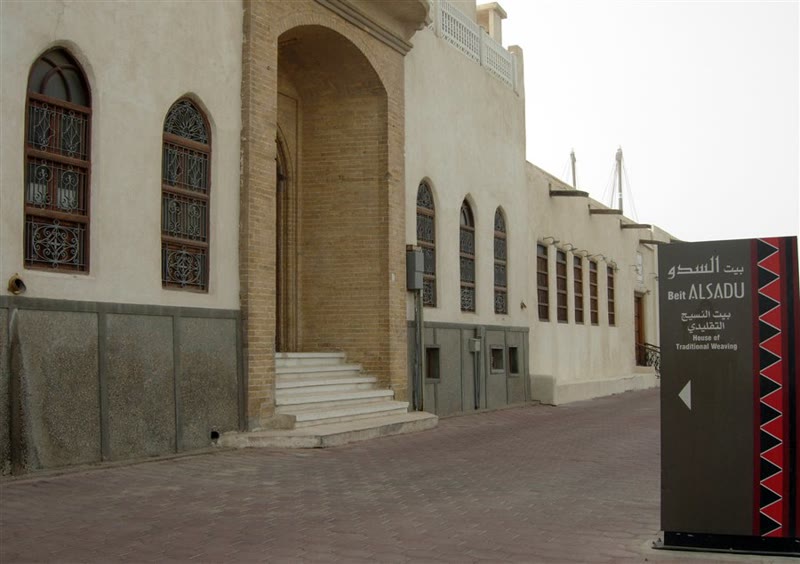
Weaving shaped for movement
Al Sadu developed within Bedouin communities as a form of horizontal ground-loom weaving. Wool and hair from sheep, goats and camels could be prepared into strong bands and panels used in tent structures, dividers, storage and furnishings. The portability of the loom and the modular logic of long woven strips belonged to a mobile way of life.
That practical account is only the beginning. Spinning, dyeing, tension, counting and assembling demand accumulated skill. Knowledge passed primarily among women, making weaving a technical and social practice rather than anonymous “folk decoration.” Changes in settlement, materials and daily life have altered the context, but contemporary makers and cultural organisations continue to teach, document and reinterpret the form.
When a label identifies a material or technique, connect it to use. A dense, hard-wearing band may have faced a different load from an ornamental element. A change in fibre or colour can reveal availability, trade or contemporary adaptation. The point is not to decode every motif into a fixed story; interpretations require evidence.
Look at rhythm before symbolism
Sadu textiles often organise colour through strong longitudinal bands, repeated triangles, diamonds and other geometric units. Stand back first. Notice the proportion between broad fields and narrow borders, the direction of movement and the way a repeated form creates pace across a long surface.
Then move closer where display rules permit. Individual yarns reveal irregularity, density and hand control that a photograph flattens. Compare natural fibre tones with stronger dyed colours, and ask whether a piece is historical, recently made, reconstructed or designed as a contemporary product. Those categories are not a ladder of authenticity; they describe different relationships to the tradition.
Terminology deserves the same care. “Sadu” may be used broadly in visitor language, while a specialist label can identify a particular technique, object or pattern. Keep the institution’s wording attached to the item. A claim that every triangle, colour or line carries one universal message is usually less useful than documented information about community, maker and use.
- Read the object label before assuming age, maker or function.
- Notice joins: large surfaces may be built from separately woven strips.
- Do not touch textiles unless the display explicitly invites it.
- Ask whether photography is permitted in the current exhibition.
Pattern becomes more useful when you ask how it was counted, tensioned, joined and used.
A cultural house, not a frozen room
Sadu House operates as a centre for preserving and presenting the weaving tradition. Its programme can include exhibitions, education, research, workshops and a shop, but these elements should be checked through the official site rather than assumed for every visit. An active cultural institution changes: a gallery may be between displays, a class may use a space or special hours may apply.
The historic domestic setting adds another layer. Courtyard proportions, shade and movement between rooms give the textiles a scale that a neutral museum box would not. Avoid treating the building as a generic “old Kuwait” backdrop. Architecture, collection and institutional work each deserve separate attention.
If craft products are available, ask about the maker, material and relationship to the cooperative or programme. Buying a well-documented contemporary piece can support continued practice; purchasing something only because it looks “traditional” does not guarantee that connection. When workshops are offered, confirm the required skill level, language, duration and registration directly before building the day around one.
Build a focused visit
Allow enough time to read, not just photograph. Sadu House pairs naturally with Dhow Harbour because both sites explain material knowledge and older forms of mobility, but check the real pedestrian route, temperature and crossings. A short vehicle connection may be more comfortable during much of the year.
Verify current opening, exhibition and workshop information on the official Al Sadu website. Events and classes may require registration; this independent guide does not reproduce a calendar or collect bookings. Dress comfortably and respectfully, keep voices low when programmes are in progress and follow staff guidance.