Maritime memory / City shore
Read the working shape.
The wooden vessels at Kuwait City’s harbour are not generic “old boats.” Their hulls point toward pearl diving, fishing, regional trade and the skilled labour that tied Kuwait to the Gulf and Indian Ocean.
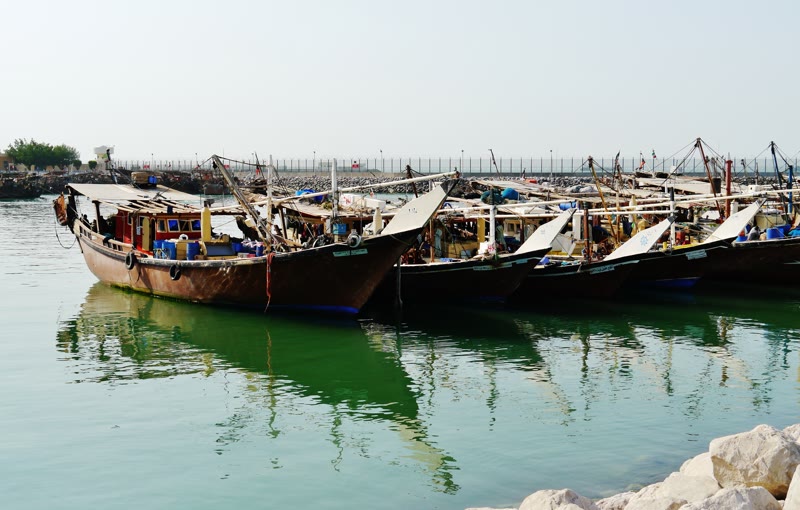
A harbour that opens the city
Before oil transformed Kuwait’s economy, the sea was a demanding source of livelihood. Merchant vessels connected the port to other Gulf communities and farther trading networks; smaller craft supported fishing and coastal movement; pearl diving depended on crews whose season involved physical risk, debt and long separation from home. Maritime heritage should therefore be read as work and social history, not as a soft decorative preface to the modern skyline.
“Dhow” is a convenient English umbrella term, but Gulf boatbuilding included different vessel forms and names suited to particular loads, distances and waters. Without an on-site label or reliable specialist source, resist assigning a precise type to every hull. Instead, begin with observable structure: length-to-width ratio, the rise of the bow, deck arrangement, steering, mast position and the way planks meet.
The harbour also reveals a material contrast. Timber had to be selected, moved and maintained in a region where large boatbuilding trees did not grow locally in abundance. The presence of wooden vessels therefore speaks to trade even before a boat leaves shore.
Boatbuilding knowledge was not contained in a drawing alone. Builders translated experience with waves, cargo, sail and available timber into decisions that crews would later trust at sea. When a hull is preserved on land or held permanently at a heritage berth, that chain can be easy to forget. Imagine the structure loaded, wet and moving—but keep the distinction between interpretation and a verified account of the specific vessel in front of you.
Look past the silhouette
Walk slowly enough to compare vessels rather than reducing the scene to one postcard frame. A broad cargo hull distributes volume differently from a narrow, faster craft. Repairs and replacement elements show that heritage objects have material lives; fresh timber beside weathered surfaces is not automatically a flaw.
Rigging, ropes and masts help explain how a crew handled sail and load, though displayed vessels may not be equipped exactly as they were in operation. Interpretation panels or museum guidance should take priority over inference. If a deck or interior is closed, viewing from the permitted edge is sufficient—do not step across barriers for a cleaner photograph.
- Use the skyline in one view to show the vessels within contemporary Kuwait City.
- Move closer for joinery, surface and repair details only where access is clearly public.
- Notice water level, reflected light and wind; the harbour changes across a short visit.
- Avoid labelling every boat as a pearl-diving vessel without evidence.
The useful question is not “How old is this boat?” but “What work was this shape built to do?”
Plan a short, weather-aware stop
The harbour belongs naturally in a morning route along the central waterfront. Exposed heat and glare can make a modest distance tiring, so bring water, use sun protection and shorten the stop when conditions require it. Dust, wind or poor visibility may also affect the experience; consult Kuwait’s meteorological service rather than relying only on a monthly climate chart.
The surrounding cultural sites may follow their own access and maintenance schedules. Do not infer that a museum or interior is open because the outdoor harbour can be seen. Check the National Council for Culture, Arts and Letters or relevant official channel for current institutional information. If a specific gallery is essential, confirm that exact space.
Sadu House is the strongest nearby conceptual pairing: wooden vessels explain exchange across the sea, while textiles explain knowledge and material culture carried across land. The two stops are geographically close but should still be connected with attention to crossings and temperature. A taxi can be reasonable even when the map line appears short.
Photograph the place, not strangers
People working near boats, security staff and other visitors are not automatic foreground material. Ask before a close portrait and obey any restriction around controlled, maintenance or working areas. Large tripods or commercial equipment may require separate permission.
Because outdoor arrangements can change, this guide does not promise a permanent vessel position, entrance or opening hour. Use the Kuwait Government visitor material and the National Council’s current information as primary starting points, then follow signs and staff instructions on the day.