Island / Archaeology / Recent memory
Plan the return first.
Failaka holds archaeological sites, settlement history and visible traces of the 1990–91 conflict. It also requires real transport confirmation, weather judgment and respect for areas that are not open for unsupervised wandering.
An island with several pasts
Failaka lies near the entrance to Kuwait Bay, a position that made it useful to communities moving goods and ideas through the Gulf. Archaeological work has identified occupation from the Bronze Age, including connections associated with the Dilmun sphere, as well as Hellenistic-period remains and later settlement. These layers do not form one simple “ancient island” story; they belong to different political, trading and religious worlds.
Names, dates and functions should be taken from current interpretation at the specific site. A low wall or scatter of stone cannot be reliably identified by appearance alone. If an organised visit includes an archaeological area, listen for what has been excavated, what remains uncertain and which reconstructions are modern.
Archaeological value often sits in relationships that are visually modest: the depth of a layer, the alignment of rooms, a seal found in a controlled context or imported material that links the island to another shore. An informed guide or well-prepared panel can make those relationships visible. Without one, describe what you actually see rather than filling the gap with a dramatic civilisation story.
Leave every fragment where it is. Removing pottery, shell, stone or metal—even an object that seems common—destroys context and may be illegal. Do not climb fragile walls or enter fenced excavation zones. The most responsible photograph is sometimes taken from the designated path.
Do not aestheticise recent damage
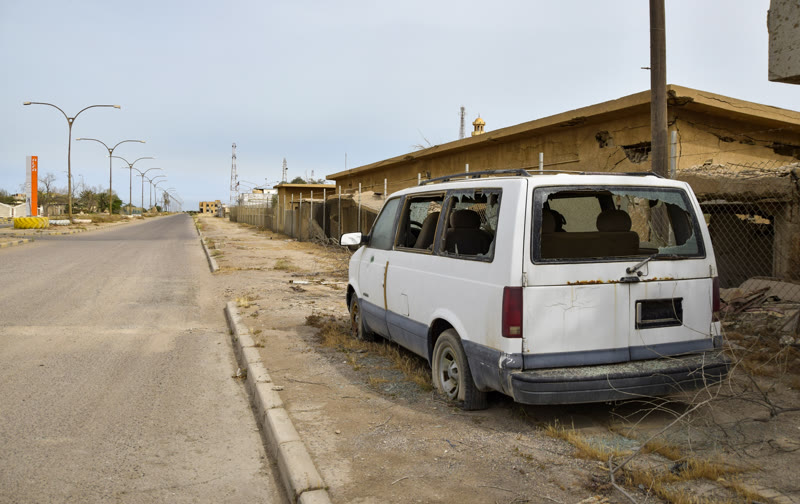
Failaka was deeply affected by the Iraqi invasion and the 1990–91 Gulf War. Abandoned or damaged structures are often photographed as dramatic ruins, but they belong to lived displacement, loss and military history. Treat them as evidence, not as an empty set for staged portraits.
Some areas may have safety, ownership or access restrictions that are not obvious from a distant image. Never enter an unmarked building, cross a barrier or explore beyond a confirmed route. Follow the operator, guide, security instructions and current official advice. A visitor’s curiosity does not override land conditions or private and controlled space.
Modern life on and around the island also matters. Avoid describing Failaka as entirely “frozen in time” or uninhabited based on one route. Visitor facilities, private operations and local activity change, and an organised day may show only a portion of the island.
A departure ticket is not a day plan until the return, meeting point and weather policy are equally clear.
Confirm the complete transport chain
Passenger services, departure points, operator arrangements and sailing times can change. This page deliberately does not publish a permanent timetable. Use a current licensed provider or official local source, and confirm the exact port, check-in time, identity requirements, baggage rules, return departure and what happens if weather interrupts service.
Do not build an international departure or non-refundable commitment immediately after the planned return. Sea conditions can affect comfort and operations even when the city weather appears manageable. Travellers prone to motion sickness should seek appropriate medical advice and understand the vessel type before booking.
- Keep the operator’s confirmed contact and meeting instructions offline.
- Carry identification required for the journey.
- Ask what transport, guiding and facilities are included after arrival.
- Know whether food and drinking water are available or must be brought.
- Confirm accessibility before paying; boats and island vehicles vary.
Prepare for an exposed day
Shade may be limited across archaeological and open areas. Bring water, sun protection, secure footwear and clothing suited to wind as well as heat. Check Kuwait Meteorological Department information close to departure. Dust, high temperature, strong wind or reduced visibility are valid reasons to reschedule.
Use toilets and supplies when available rather than assuming the next stop will have them. Keep waste with you until a proper bin is found. Photograph people only with permission, and avoid filming security or controlled infrastructure.
If reliable transport or site access cannot be confirmed, choose a city route. That is not a lesser trip: Dhow Harbour, Sadu House and cultural venues can explain Kuwait’s relationship with movement and material culture without the operational uncertainty of a sea crossing.